Your heart is a strong muscle, and the organ works hard every day to pump
an average of 7,000 liters of blood every 24 hours. The heart is built
to last a long lifetime, and with proper care, it will. However, human
lifestyles have significantly changed in modern years, testing the limits
the heart was built to accommodate.
Heart disease is a leading killer in the United States. Our bodies were
not designed to routinely eat fatty or sugary foods without getting proper
exercise. Unfortunately, high blood pressure and high cholesterol often
have no warning signs, leaving many people ignorant about their current
heart health. For this reason, everyone should have their blood pressure
and cholesterol checked at least once every two years.
Comprehensive Cardiovascular Services
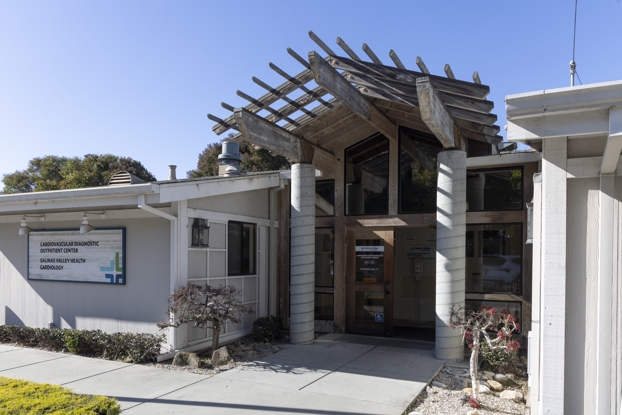
Our cardiology care at Salinas Valley Health serves to educate patients
on how to keep their heart healthy. Our skilled team of cardiac physicians
work together to perform cardiovascular health treatments through the
Central Coast Cardiology facility, offering many cardiothoracic surgeries.
The following are warning signs that you need a heart checkup:
Tight feeling in chest
Difficulty breathing
Feeling winded after climbing stairs
Heart starts pumping faster for no reason
Loud snoring, as this could result from sleep apnea, which impacts your
cardiovascular system
Constant coughing
Remember: Heart disease is called the silent killer for a reason. While
you may have symptoms that hint at a problem, it is highly likely that
there will be no signs until it’s too late. With regular physicals
you can stay on top of your heart health and remain confident that everything
is working as it should.
Overview of cardiology and cardiovascular services:
Vascular Interventional Procedure - The percutaneous trans-arterial bypass (PTAB) is a minimally invasive
cardiovascular procedure, a major advancement to treat severe blockage
of the arteries in the legs.
Electrophysiology– Our specialists provide the most advanced diagnostics and treatments
available today for individuals with an irregular heartbeat (cardiac arrhythmia).
Cardiothoracic surgery – We offer outstanding cardiac surgical care for those in the region,
including advanced surgical solutions for patients with complex heart
health issues.
Cardiac rehabilitation – With an on-campus Cardiac Fitness Center, we are able to provide
comprehensive cardiac rehabilitation for people who recently suffered
a heart attack, underwent heart surgery or have heart disease.
Interventional cardiology – Our state-of-the-art cardiac catheterization laboratories perform
innovative, sophisticated interventional procedures paired with world-class
care from our team.
Transcatheter aortic valve replacement (TAVR)– TAVR is a minimally invasive alternative to open-heart surgery. The TAVR
procedure is done in a cardiac catheterization lab by an interventional
cardiologist. A catheter is used to introduce an artificial heart valve
through a blood vessel in the patient’s groin. The catheter is guided
up to the heart, where the new valve is positioned inside the defective
aortic valve, opening up blood flow and allowing the heart to pump more
efficiently. The entire procedure takes less than two hours, and patients
usually go home within one or two days.
Click here to learn more.
WATCHMAN LAAC™ cardiac implant– This cardiac implant offers an alternative to blood thinners to reduce
stroke risk for people with atrial fibrillation not caused by a heart
valve problem. The nonsurgical procedure, known as left atrial appendage
closure (LAAC), is done in a cardiac catheterization lab using a catheter
inserted into a blood vessel in the patient’s groin. The Watchman
device is implanted into the left atrial appendage, which is the small
pocket inside the heart where blood clots tend to form. The procedure
takes about two hours and patients spend one night in the medical center.
Over 90% of patients are able to safely stop taking blood thinner medication
about six weeks after the procedure.
Click here to learn more.
Patent Foramen Ovale (PFO) closure – The patent foramen ovale (PFO) closure device placement procedure
is a catheter-based procedure. A catheter is used to guide the placement
of a PFO closure device that will close the hole (prevent the flap from
opening) in the heart wall. Once the device is inserted, it becomes a
permanent implant. Here at Salinas Valley Health, we use the Amplatzer™
PFO Occluder, which is the industry-leading device for this procedure.
To read more on the Amplatzer™ PFO Occluder,
click here.
MitraClip™Therapy - MitraClip™ repairs leaky mitral valves without open-heart surgery
and is delivered to the heart through a small incision in the leg. The
non-surgical treatment works by clipping together portions of the leaflets,
or flaps, of the mitral valve in order to reduce Mitral Regurgitation,
which allows the heart to pump blood more efficiently, thereby relieving
symptoms and improving patient quality-of-life.
Click here to learn more.
Noninvasive cardiology–We perform thousands of cardiac diagnostic studies every year, utilizing
a team effort to pioneer the latest noninvasive cardiology solutions.
HEART ATTACK
Know the signs and symptoms of a heart attack:
Chest discomfort
Shortness of breath
Arms, neck and back pain
Fatigue and cold sweat
Every minute counts. Call 911.
STROKE
Know the signs of a stroke.
Use the FAST test to remember warning signs of stroke: